
China Best Abrasion Resistant Rubber Hose Manufacturer?
Choosing the best Abrasion Resistant Rubber Hose manufacturer in China requires more than comparing prices or catalog photographs. The right supplier must understand what the hose faces daily: sharp gravel, mineral slurry, cement dust, pressure surges, and repeated bending. A hose may look strong outside. Its tube, reinforcement, cover, and coupling design determine whether it survives real service.
Rubber technology expert Dr. James E. Mark offers a useful principle: “Material structure and formulation control performance.” This idea matters when evaluating Chinese manufacturers. A credible factory should explain its rubber compound, abrasion testing method, working pressure, temperature range, and reinforcement structure. It should also provide traceable inspection records. Standards such as ISO 4649 or DIN 53516 can support meaningful wear comparisons, although laboratory results never replace field experience.
Look closely at production details. Does the manufacturer test hose samples after vulcanization? Can it show batch records and coupling inspections? Does its engineering team recommend different designs for dry powder, wet slurry, or heavy aggregate? These questions reveal practical competence. Factory audits, customer references, and independent testing add further confidence.
The word “best” remains subjective. A supplier that excels in mining applications may not suit dredging or concrete pumping. Even a reputable factory can miss a defect. That is why trial orders, installation guidance, and after-sales support deserve attention. The strongest China-based manufacturer is not merely the cheapest option. It is the partner that connects compound science, controlled production, honest documentation, and proven performance in demanding environments.
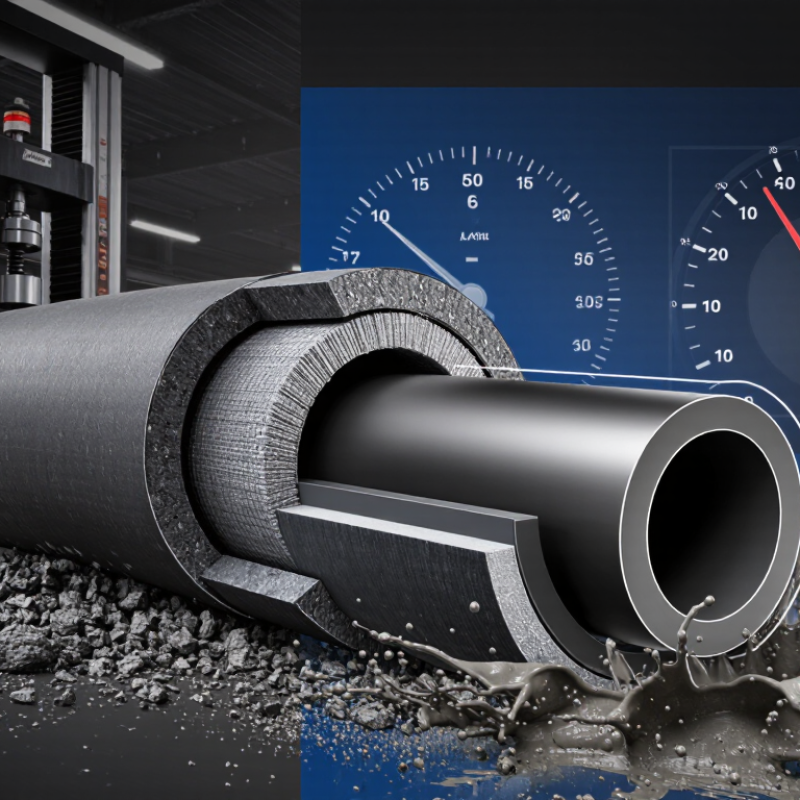
Abrasion Resistant Rubber Hoses: Definition, Structure, and Core Functions
Abrasion resistant rubber hoses are flexible pipelines designed to transport materials that wear down ordinary tubing. They handle slurry, sand, gravel, cement, and other abrasive mixtures. Their main value is longer service life under repeated friction. However, no hose suits every application.
A typical hose has three working layers. The inner tube uses dense, wear-resistant rubber to resist cutting and material impact. Textile or steel reinforcement supports internal pressure and prevents excessive stretching. The outer cover protects against sunlight, moisture, abrasion, and moderate mechanical damage. In practical operations, hose performance also depends on bend radius, pressure rating, temperature, and material concentration. A strong hose can still fail when installed too tightly. Field inspection often reveals overlooked twisting or unsupported weight.
Tips: Check the conveyed material before selecting a hose. Sharp particles need stronger abrasion resistance. Confirm pressure during start-up, not only normal operation. Keep the hose away from sharp edges and avoid forced bends. Inspect the inner wall regularly, because external surfaces may look acceptable while internal wear progresses. Recording service hours and failure locations improves future selection. This process is not perfect, but it provides useful evidence for safer replacement decisions.
Key Materials and Manufacturing Standards for Chinese Rubber Hose Producers
China Best Abrasion Resistant Rubber Hose Manufacturer?
Material selection determines hose life in mining, aggregates, and heavy construction. Natural rubber offers strong elasticity and good resistance to coarse particles. SBR can reduce cost while maintaining useful abrasion performance. NBR suits oil-contaminated environments, but it may age faster under sunlight. UHMWPE liners provide very low friction and excellent wear resistance. They also increase material costs. No compound wins every test.
The International Rubber Study Group reported global natural rubber demand near 15 million tonnes in 2023. This scale increases pressure on producers to control compound consistency and sourcing. Chinese manufacturers should verify polymer grades, carbon black dispersion, plasticizer content, and cure uniformity. A hose may look smooth outside. Its inner liner can still contain weak bonding or uneven thickness. That hidden defect deserves more attention.
Reliable production should reference ISO 4649 or DIN abrasion testing for material wear. ISO 18752 also defines performance classes for hydraulic hose construction. Reinforcement may use high-tensile steel wire, textile yarn, or aramid layers. Each choice affects pressure, flexibility, and fatigue resistance. Manufacturers should record batch data, vulcanization temperature, and test results. Independent laboratory checks strengthen credibility. Yet paperwork cannot replace field experience. Dust concentration, sharp rock edges, and repeated bending often expose weaknesses that laboratory testing misses. A cautious buyer should request traceable samples and realistic service-condition testing.
How to Evaluate a China-Based Abrasion Resistant Hose Manufacturer
A reliable evaluation starts with evidence, not attractive product photos. Grand View Research’s 2024 industrial hose analysis identifies mining, construction, and material handling as major demand sectors. These applications punish weak rubber compounds quickly. Ask the manufacturer for compound specifications, reinforcement details, and batch traceability. Request abrasion test results using ISO 4649 or ASTM D5963. Test reports should show volume loss, test conditions, sample numbers, and laboratory details. A low result matters only when the method is clear.
Check practical manufacturing control. Visit the factory, if possible, or request dated production videos and inspection records. Review mixing, extrusion, vulcanization, and final pressure testing. The International Organization for Standardization links hose reliability with controlled dimensions, pressure performance, and material consistency. Ask how rejected batches are isolated. Also confirm whether the stated working pressure includes a safety margin. Some suppliers quote impressive figures without explaining temperature, fluid, or bend-radius limits. That is a warning.
Tips: Compare three recent batches, not one perfect sample. Send a hose section to an independent laboratory. Inspect the cover for cracks, uneven texture, and exposed reinforcement. Then run a short field trial with abrasive slurry. It may reveal problems that certificates miss. One weakness in this process is obvious: remote evaluation cannot fully replace long-term site experience. Keep communication records, drawings, and approval samples before production. A dependable manufacturer should answer technical questions precisely, admit limitations, and correct data when new testing proves it wrong.
Performance Testing, Quality Control, and Product Certification
China Best Abrasion Resistant Rubber Hose Manufacturer?
Performance Testing, Quality Control, and Product Certification
Choosing the best abrasion resistant rubber hose manufacturer in China requires evidence, not attractive catalog claims. Performance testing should begin with the rubber compound. Laboratories can measure volume loss under controlled abrasion, using recognized methods such as ISO 4649. Pressure, impulse, leakage, and bend tests reveal different weaknesses. Small details matter. Record the test temperature, load, duration, and sample batch. Without those details, results are difficult to compare.
Quality control must continue beyond the laboratory. Inspectors should verify inner diameter, wall thickness, cover hardness, reinforcement placement, and surface finish. Each production batch needs traceable compound and reinforcement records. Hydrostatic testing can expose pinholes or bonding problems before shipment. Visual checks still matter. However, visual inspection alone is not enough. An experienced supplier also controls curing time and temperature, because small variations can reduce service life. That point is often underestimated.
Product certification should match the hose’s intended service and destination market. Ask for current certificates, test reports, material declarations, and calibration records. Independent laboratory verification adds credibility, especially for abrasive slurry, mining, or heavy material-transfer applications. Certificates are useful, but they do not replace application engineering. A hose may pass a standard test and still fail after sharp bends, heat, or poor coupling. Field feedback should return to design and inspection teams. That loop is not always perfect. Manufacturers should acknowledge gaps, investigate failures, and improve specifications rather than hide inconvenient data.
China Best Abrasion Resistant Rubber Hose Manufacturer? Performance Testing, Quality Control, and Product Certification
The chart presents representative laboratory screening values for common rubber compounds tested by the DIN 53516 or ISO 4649 abrasion method. Abrasion loss is measured in cubic millimetres, and lower values indicate better wear resistance. Actual results depend on formulation, reinforcement, curing conditions, test load, and test speed. Final hose qualification should also verify tensile strength, pressure performance, dimensional stability, and applicable certification requirements.
Applications, Customization Options, and Supplier Selection Criteria
China Best Abrasion Resistant Rubber Hose Manufacturer?
Abrasion resistant rubber hoses serve demanding applications such as mining slurry, sand transfer, gravel handling, cement discharge, and ceramic production. In daily operation, sharp particles scrape the tube wall during pumping. A hose that looks strong can still fail around bends, couplings, or poorly supported sections. Operators should check pressure, temperature, particle size, flow speed, and suction conditions before choosing a design. Field experience matters. Inspecting a hose after each shift can reveal polished areas, blisters, or uneven wear before leakage begins.
Customization should match the working system, not only the catalog dimensions. Options may include inner diameter, wall thickness, hose length, reinforcement layers, bend radius, flange type, and working pressure. A smooth inner tube can reduce turbulence, while a thicker wear layer may extend service life in heavy slurry applications. However, thicker is not always better. It can increase weight and reduce flexibility. This trade-off is often missed.
Supplier selection requires evidence rather than confident claims. Ask for rubber compound specifications, pressure test records, dimensional reports, and batch traceability. A reliable manufacturer should explain its compound, reinforcement structure, temperature limits, and expected service conditions clearly. Sample testing under actual media is valuable, especially when the slurry contains sharp stone or metal particles. Check whether the supplier offers fitting support, replacement guidance, and responsive technical communication. Delivery promises also deserve verification through production schedules and previous inspection records. Mistakes happen, but vague answers and missing test data deserve careful reconsideration.
China Best Abrasion Resistant Rubber Hose Manufacturer? - Applications, Customization Options, and Supplier Selection Criteria
| Application | Typical Conveyed Material | Typical Operating Temperature | Typical Working Pressure | Recommended Hose Construction | Customization Options | Key Supplier Selection Criteria |
|---|---|---|---|---|---|---|
| Mining Slurry Transfer | Water-based mineral slurry, tailings, ore concentrate | Approximately -30°C to +80°C | Commonly 10–25 bar, depending on design and diameter | Thick abrasion-resistant tube, textile or steel reinforcement, anti-static cover when required | Inside diameter, length, flange type, bend radius, tube thickness, cover compound | Abrasion test data, pressure testing, dimensional consistency, field service history |
| Sandblasting and Shot Blasting | Dry sand, steel shot, mineral grit, abrasive blasting media | Approximately -30°C to +80°C | Usually 7–12 bar for blasting service | Static-dissipative or conductive tube, abrasion-resistant rubber, durable outer cover | Anti-static specification, nozzle connection, coupling configuration, color coding, length | Electrical resistance verification, tube wear resistance, coupling security, safety documentation |
| Cement and Concrete Handling | Concrete, cement powder, mortar, dry bulk materials | Approximately -30°C to +80°C | Commonly 6–12 bar, application-dependent | Heavy-duty abrasion-resistant tube with reinforced construction and abrasion-resistant cover | Smooth or corrugated cover, customized ends, anti-static tube, special bend radius | Resistance to dry-powder wear, flexibility, hose weight, end-fitting retention, quality control |
| Dredging and Marine Discharge | Dredged sand, silt, gravel, seawater slurry | Approximately -30°C to +80°C | Often 10–20 bar, subject to dredging system design | Thick-walled slurry hose, high-strength reinforcement, marine-resistant cover | Floating or submerged configuration, flange drilling, buoyancy components, extra wear layer | Buoyancy and bend performance, seawater resistance, flange alignment, fatigue testing |
| Coal and Mineral Conveying | Coal, limestone, iron ore, crushed rock, mineral dust | Approximately -30°C to +80°C | Typically 6–16 bar for pneumatic or mechanical conveying systems | Abrasion-resistant tube, static-control capability where needed, reinforced cover | Tube compound, wall thickness, electrical resistance, installation length, fitting style | Material compatibility, static-control performance, pressure rating, wear-life evidence |
| Steel Mill and Foundry Service | Scale, slag particles, cooling water, abrasive solids | Usually -30°C to +80°C for the hose body; higher external radiant heat requires special protection | Commonly 10–25 bar, according to service requirements | Heat-resistant cover where necessary, abrasion-resistant tube, high-strength reinforcement | Heat shields, protective sleeves, flame-resistant cover, custom end fittings, bend radius | Temperature mapping, cover protection, impulse and pressure testing, traceability of materials |
| Industrial Vacuum and Recovery | Abrasive dust, sludge, granular waste, contaminated liquids | Approximately -30°C to +80°C | Vacuum service; positive-pressure rating depends on construction | Flexible abrasion-resistant tube with vacuum-supporting helix or reinforcement | Vacuum level, helix material, flexibility, cuff style, length, static-dissipative design | Collapse resistance, minimum bend radius, static-control testing, connection compatibility |
| General Supplier Evaluation | Not applicable | Confirm actual media and operating temperature range | Verify working pressure, surge pressure, and vacuum requirements | Check rubber compound, reinforcement, cover, tube thickness, and end connections | Request drawings, samples, prototypes, inspection reports, and production lead times | Review relevant standards, factory quality controls, batch traceability, testing capability, warranty terms, and technical support |
Note: The temperature and pressure values shown are typical reference ranges for industrial hose selection, not universal ratings. Final specifications should be confirmed against the hose construction, conveyed material, flow velocity, installation conditions, surge pressure, and applicable safety standards.
Article Source:
CORPORATE HEADQUARTERS
North America
California
AGIC Energy North America LLC
13025 Danielson Street, Suite 105
Poway, CA 92064 – USA
Phone Number: +1 (858) 842 1513
Email: info@site_cc52bd27-560c-4f9d-bd66-63718fc42539
Sales: sales@site_cc52bd27-560c-4f9d-bd66-63718fc42539
